How to Make a Sourdough Starter From Scratch: A Beginner’s 7-Day Guide
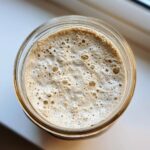
Create your own healthy, active sourdough starter from scratch using just flour and water. This beginner sourdough guide walks you through the day-by-day process for making homemade wild yeast culture for artisan bread making at home.
- Prep Time: 5 min
- Cook Time: 0 min
- Total Time: 7 days (active time is minimal)
- Yield: One active starter culture
- Category: Baking Basics
- Method: Wild Fermentation
- Cuisine: American
- Diet: Vegetarian
Ingredients
Scale
- 100g Whole Wheat Flour or Rye Flour (for initial days)
- 100g Unbleached All-Purpose Flour (for later feedings)
- 100g Unchlorinated Water (room temperature)
Instructions
- Day 1: Mix 50g whole wheat or rye flour with 50g room temperature water in a clean jar. Stir well until no dry spots remain. Cover loosely and leave at room temperature (ideally 70-75°F or 21-24°C) for 24 hours.
- Day 2: You may see small bubbles or nothing at all. Discard half of the mixture. Add 50g of all-purpose flour and 50g of water to the remaining starter. Mix thoroughly, cover loosely, and wait 24 hours.
- Day 3: You should see some activity, perhaps a few bubbles or a slight sour smell. Discard half. Feed with 50g all-purpose flour and 50g water. Wait 24 hours.
- Day 4: Activity might slow down; this is normal. Discard half. Feed with 50g all-purpose flour and 50g water. Wait 24 hours.
- Day 5: You should see more consistent bubbling. Discard half. Feed with 50g all-purpose flour and 50g water. Wait 24 hours.
- Day 6: The starter should be showing reliable signs of life, doubling in size within 6-8 hours after feeding. Discard half. Feed with 50g all-purpose flour and 50g water. Wait 24 hours.
- Day 7 (and beyond): Your sourdough starter is active when it consistently doubles in volume within 4-8 hours after feeding. Switch to a twice-daily feeding schedule if you plan to bake soon. Discard half, then feed with 50g flour and 50g water, twice a day, 12 hours apart.
Notes
- Use filtered or bottled water if your tap water is heavily chlorinated, as chlorine can inhibit yeast growth.
- Maintain a consistent room temperature for best results; cooler temperatures slow down fermentation, warmer temperatures speed it up.
- When your starter reliably doubles after feeding, it is ready for baking. This is your active sourdough starter.
- To maintain your starter long-term, store it in the refrigerator after it peaks, and feed it once per week.
Nutrition
- Serving Size: 1/4 cup culture
- Calories: 120
- Sugar: 0.5g
- Sodium: 1mg
- Fat: 0.3g
- Saturated Fat: 0.1g
- Unsaturated Fat: 0.2g
- Trans Fat: 0g
- Carbohydrates: 25g
- Fiber: 1.5g
- Protein: 4g
- Cholesterol: 0mg